
The Department of Health Economics is looking for a part-time (20 hours per week) Senior Scientist (pre-doc) (m/f/x) to start on January 7th, 2027 on a fixed-term position until September 30th, 2030.
Deadline for applications: 11 November 2026
A new study led by Michael Berger from the Department of Health Economics has been published in the top journal Social Science & Medicine. This research is a collaboration with the Helsinki Institute for Demography and Population Health and part of Michael Berger’s FWF Erwin-Schrödinger scholarship “Mortgages, Household Economic Resilience and Health”.
The paper explores whether mortgage debt temporarily offsets the protective effect of homeownership on mental health. The findings suggest that while mortgage strain worsens mental health primarily in the run-up to job loss in comparison to other homeowners, new homeowners still retain a longer-term advantage compared to tenants even when they experience job loss.
Read the full publication here.
We congratulate Peter Gamillscheg-Müllner on the successful defense of his PhD-thesis!
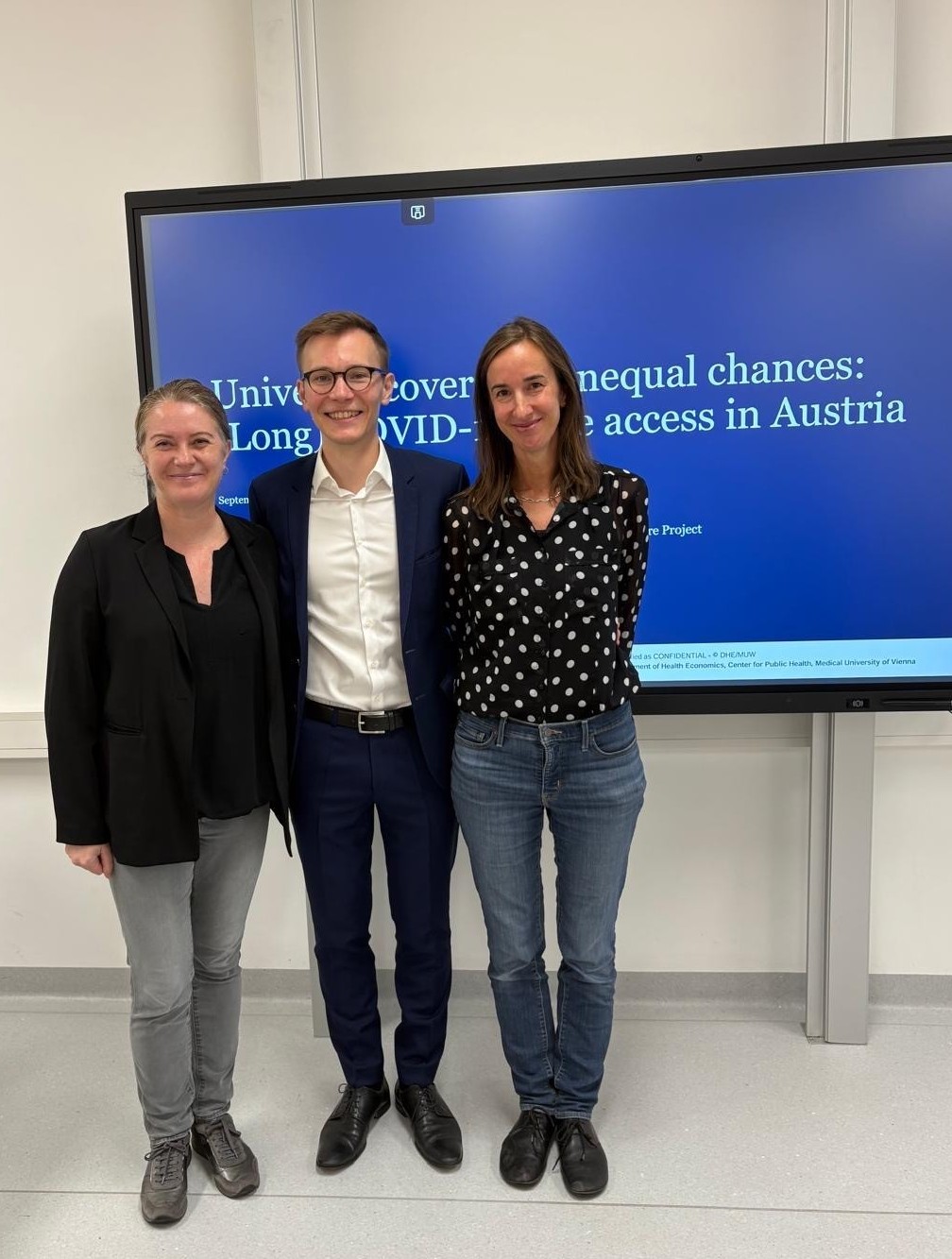
Title: “Universal coverage, unequal chances: (Long) COVID-19 care access in Austria”
Supervisors: Univ.-Prof. DDr. Judit Simon, Assoz. Prof. Dr. Susanne Mayer
Department: Center for Public Health, Department of Health Economics (DHE)
New Nature commentary published related to the interlinkage of climate and environmental hazards and mental health with contribution from Judit Simon, Department of Health Economics, Center for Public Health.
The work “Why environmental treaties must also address mental health” highlights the problem that global conventions largely overlook psychological and social impacts of climate change, biodiversity loss and pollution, and presents a new framework to support change.
Wegweiser psychische Gesundheit – Wien: New, comprehensive, publicly accessible, mental health services atlas released for Vienna.
The atlas was developed by the Department of Health Economics (Center for Public Health, Medical University of Vienna) as part of the WWTF-funded STREAMLINE project and provides a comprehensive overview of organisations that deliver mental health care services for children, youth, adults, as well as their families and carers, in the health, social, work, education and informal care sectors in Vienna.
“Comparing Machine Learning Methods for Personalized Treatment Allocation” by Assistant Professor Noémi Kreif
(Comparative Health Outcomes, Policy and Economics (CHOICE) Institute, University of Washington School of Pharmacy)
Evidence from published studies on healthcare access barriers faced by long Covid patients in Austria, produced as part of the Post COVID-19 Care project, was presented by Dr. Mmag. Susanne Mayer at the ME&WE stakeholder meeting on 2 June 2026 in Vienna. The presentation “Zugangsbarrieren für Long-COVID-Patient:innen in Österreich” highlighted challenges experienced by patients in navigating the Austrian system and accessing appropriate care.
Further information on the Post COVID-19 Care project can be found here.